Human Capital is a Depreciating Asset

Human Capital is a Depreciating Asset


This post was originally posted on the Sibme blog

I want you to imagine for a bit that you own a major manufacturing plant. You produce something that is vital to the health of the country. Let’s say it’s candy bars. Without your candy bars, the country would collapse. Economic output would stop, society would no longer be able to function as a whole, the government would shut down, key infrastructure would fail…chaos. These candy bars are the very life-blood of our nation. We cannot survive without these candy bars.

To produce these candy bars, you need several different pieces of equipment. And you work very hard to get the best versions of this equipment around. You shop around, you negotiate deals, you carefully ship the equipment to your manufacturing plant. And on Tuesday, all of the equipment arrives. The equipment that produces the candy bars that the country can’t live without has arrived!


Then what do you do?


Well…this equipment is important. So, of course, you gingerly set the equipment up. You hire knowledgeable people to run the equipment, you hire people to manage the people who run the equipment, you monitor the performance of the equipment. And whenever something gets worn, or something breaks, you immediately bring someone in to maintain it. That’s what any thoughtful candybar mogul would do, right? After all, this equipment is vital to the success of your company, and to the health of the country. 


Throughout the life of this equipment, the manufacturer might offer you upgrades on the equipment. Sometimes those upgrades are unnecessary and you might choose to avoid them. But you will consider each product update to make sure that your equipment is the best it can be. 


And regularly, perhaps even monthly, you’ll work carefully to maintain that equipment. You’ll oil it’s gears, you’ll make sure it’s nuts and bolts are all tightened. You’ll even hire people to come in and provide regularly scheduled maintenance to keep things running smoothly. 


You’re a good and honest steward of your company. You do well to invest resources, time, and money in the maintenance of your equipment. That’s because you understand one of the fundamental rules of Economics: capital depreciation. 


Of course, all of the resources you use to make your candy bars are capital. But this machinery is the most important kind of capital. In case it’s been a few weeks since your last Economics course, capital is any asset you use to produce goods. All capital has value, and different types of capital have different worth to different people or companies. But this capital. This beautiful machine that produces these vital candy bars, this machine is the most important capital to you. So it’s value is very high.


But, inevitably, the value will go down over time. This is another fundamental law of economics: depreciation. Depreciation simply means that the value of certain types of capital goes down over time. That’s because it’s ability to contribute to the production of goods becomes more costly, or it becomes more inefficient. So, this beautiful machine, which can produce 100,000 candy bars an hour on day one, will eventually produce 99,999 candy bars in an hour. As the gears get rusty, the machine runs slower, and it becomes inefficient.


So we’re back to maintenance. All assets have a valuable life, the time-span over which they can produce goods in a cost-effective and efficient manner. There will come a day where the machine will seize up, the gears will no longer turn, and the number of candy bars it can produce will go to zero. And you’ll have to replace it. It will no longer be valuable capital. But your goal, as a prudent businesswoman, is to cast that fateful day as far into the future as possible–at least as long as it’s cost-effective to do so. That’s why we take our cars to get the oil change. And we clean out the lint traps on our driers. And we clean the oven once every…well…ten years if you’re like me. We want to prolong the life of our assets. Because, up until a point, it’s cheaper to maintain the capital you’ve got than it is to acquire new capital. 

Human Capital


Of course, you don’t make candy bars. 

In fact, you may not make anything anymore. 

And maybe you don’t use much machinery. 

But you still have lots of Capital that you use. 

We have a very different kind of capital: Human Capital. 


Of course, people are very different from machines. But the people on your team and the candy bar machine have one thing in common: without them, you wouldn’t exist. So here’s the big question: do you treat your people the way you treat valuable equipment?


Every manager says they do. This article from Ethan Rouen considers the accounting ramifications of talking about people as “our most valuable asset” versus treating people like one. 


Balance sheets aside, the real question is about maintaining value. The same way that physical capital is made up of parts and components that must be maintained to prevent depreciation, all of us have components (skills, knowledge, ability) that must either be maintained or replaced. That granular approach to human capital is rare, though. Most employers think of people as a whole unit, rather than as a sum of strengths. This is a mistake. Often, the consequence is that a person, who’s skills, knowledge, and ability —which I’ll refer to as Human Capital from now on—inevitably depreciates in value over time, gets tossed aside long before their “depreciable life” is up. Any manager who throws out a piece of equipment simply because a single gear breaks would be considered foolish and wasteful. But we often look to replace people when one or two of their skills no longer “do the job.” Instead of thinking of ways to improve or replace the Human Capital, employers often just replace the human. 


The tricky thing is that you can look in a catalog, see how much a new computer costs, and see how much it would cost to replace your existing computer’s CPU or upgrade it’s memory. That allows you to make a simple calculation to decide what’s more efficient. The hidden cost of hiring a new person versus “upgrading” the Human capital of your existing team is much more difficult to quantify. But it’s not impossible. The Work Institute estimates that it costs as much as 33% of an employee’s salary to replace them. So unless you can hire someone else at ⅔ the cost of your current employee, it’s probably worth considering how you can keep their Human Capital from depreciating rather than just kicking them to the curb for a shiny new person. And there are a host of other hidden costs. When people start getting fired, workplace productivity is affected by gossip, changes in morale, and the added cost of interviewing, on boarding, and enculturating their replacement. 


So if it’s costly to replace human capital, and maintenance is the better option in most cases, who’s supposed to do the maintenance? Many employers might tacitly say that they want to invest in their most “valuable asset” but then turn around and say the best solution is to “hire right.” Hiring right is like buying a shiny new machine. It’ll be great for a while, but everyone’s human capital depreciates over time. And still, how do you even know that the person you hire even has the human capital you need? 

So, you’ve got these people. And hopefully by now you’re convinced that you need to invest in keeping them from depreciating. But how do you do it?


Most employers approach this in one of two ways:


  1. “It’s their problem not mine.” Performance reviews look like this. Often, The review does little more than tell the employee what they’re doing wrong. Imagine the same situation with a piece of physical capital? Would you just tell a machine what’s wrong with it and expect it to fix itself? Of course not! Of course, people are smarter than machines. One of our strengths is our ability to learn on our own. But most of the time, even that isn’t enough. 
  2. Ineffective solutions. Many employers go so far as to seek out —and invest small fortunes in—potential solutions to the problem. They purchase books, virtual curriculums and “how to” videos to show their employees what effective Human Capital is. Or perhaps they’ll go so far as to gather a bunch of people in a room for an afternoon and hire a consultant to come in and tell them what effectiveness is. At best, these solutions are ineffective, and more commonly, they’re worthless, costly, and time-consuming. Consider again our Candy Machine. Would you let the machine watch a newer machine, or would you bring in a mechanic and have them just TALK to you about how the machine SHOULD be running? I hope not. That would be a huge waste of money. Again, yes, people aren’t machines. But there’s tons of research that information sharing is only the starting line, not the finish line. Everyone who wants to improve knows that there’s only one way to get to Carnegie Hall: practice. If you brought in a mechanic, you wouldn’t pay them a cent to sit in your office and tell you what your machine should be doing. You’d insist that they get to work—oiling gears, taking out the parts that have worn out and putting in new components. If you hire a consultant and they don’t do the exact same thing with your human capital, send them packing. (And, really, you probably shouldn’t hire them in the first place, they rarely have the time it takes to do the actual work necessary to help your team hone their skills and practice new ones to replace their outdated human capital.)


Instead of wasting valuable time and money on these insufficient and ineffective solutions, individuals and teams need to work collectively to keep human capital from depreciating systematically. Really, the work falls into three steps:

Human Capital Components


Look at the “parts” you need

Every organization produces something. It might not be candy bars–It might be car parts or students who know how to solve quadratic equations–but if you’re not producing something that’s valuable, you wouldn’t exist. And producing those things requires certain capital, both physical and human. So the first step is to look at what you produce, or what you’d like to produce, and see what capital you need to produce it. Creating and maintaining an inventory is the first step to knowing where you’re going. Organizations skip this step too often. They look at “the products” they want to produce, but they give little more than a glance at what it takes to actually produce them . I don’t know anything about candy bars or cars, but I know about teachers, and I’ve seen this step skipped many times in learning organizations. Saying “we have 300 students that need to learn the quadratic equation, so we need 10 math teachers” is not nearly enough to accurately identify your “capital requirements” to achieve your “product.” What does it take for your 300 students to learn quadratic equations? What human capital do the 10 teachers need to be effective? That’s the important work. 


Look at the “parts” you’ve got

For many organizations, the closest anyone gets to addressing human capital depreciation is a performance review. Done properly, performance reviews can be a helpful part of the process, but they are only part of the process. Only after completing an accurate inventory of what the organization needs should you consider performance reviews of any kind. The idea of reviewing a person’s performance should only be connected to the human capital required in your organization. Right next to your inventory of “required parts” from step one should be a way of tracking who’s got the human capital you need, who’s human capital needs to be refreshed, and what human capital each person needs to set aside to make room for new human capital. This will help you plan collaboratively to martial meaningful resources to keep your human capital up to date. 


Get to work maintaining

Once you’ve got an idea as to what needs to be oiled, what needs to be removed, and what needs to be replaced to keep your human capital in tip-top shape, start doing it. Don’t hire the mechanic first, your organization is made up of mechanics! Pair people in iterative relationships so they can help one another maintain collective human capital. Everybody does something well, and nobody does everything well. Devote time and energy to this work. Don’t just do it once a quarter. Parts can get wobbly if left alone for too long. You need people to work together everyday to keep things running smoothly. 


A note about hiring outsiders to help with this process: When you bring in an outsider to maintain your human capital, it is the least efficient solution. There’s no way they’ve gone through steps 1 & 2 with you, so even if they’re experts in quadratic equations, they don’t know your people as intimately as you do. So be careful when bringing them in. If you manage a sales team and you hire a consultant, don’t tell the consultant “I need better sales people.” You’ll get nothing but an expensive consulting invoice in return. Be specific when hiring a contractor, and monitor their work closely to make sure they’re fixing the problem you want fixed. 


Human Capital InvestmentThese three steps must be embedded in the culture of your organization. Measure it, talk about it, devote time and energy to it, and when somebody does the hard work of refreshing their human capital, reward it!!!! After all, they’ve saved you tons of money by not making you hire someone new to replace them. 


People often think of the process of building and maintaining human capital when they aren’t in the workforce. It’s a mistake to believe that we spend the first twenty or so years of our lives “building the machine” and then put it to work. The only thing that happens when we leave the education stage of our lives and enter the workforce, for most people, is that we stop the much-needed maintenance work. But that doesn’t mean we start depreciating at that moment. In actuality, when we enter the workforce and stop learning, depreciation doesn’t start, it accelerates. So then we become obsolete more quickly, and only then do we think about gaining new human capital. Don’t do that. Organizations, and the people inside of them, only survive when everyone learns everyday. And do the hard work at looking at your human capital and deciding what needs to be removed to make room for new parts. This problem exists in every sector of the job market. Some estimates indicate that there will be a shortage of 85 million people in the workforce by the year 2030. That’s not for a lack of humans…it’s for a lack of human capital. It’s up to all of us to solve that problem, both as individuals and as organizations. Nobody’s going to solve it for us!

The Coming Crisis in Education

Schools and school leaders spend a lot of time thinking about many crises in education, but many of them focus on student trends: test scores, changing demographics, declining literacy rates and the like. But there’s another crisis that few people on campuses around the country focus on: changes in the teacher workforce. Ignoring this crisis is to the peril of students in all schools. As these changes continue to grow—and they will continue to grow—the negative impact on classrooms will become more apparent than it already is today.

In an October 2019 presentation to the Consortium of State Organizations for Texas Teacher Education (CSOTTE), the Texas Education Commissioner Mike Morath shared some troubling statistics about workforce trends among Texas’ teachers. It’s always dangerous to extrapolate national trends from Statewide data, but similar trends have been cited by researchers at universities around the country and even the US Department of Education.

The most troubling statistics?

  • 1 million teachers quit every year
  • A growing number of those teachers aren’t quitting to go work at another school; they’re quitting teaching altogether.
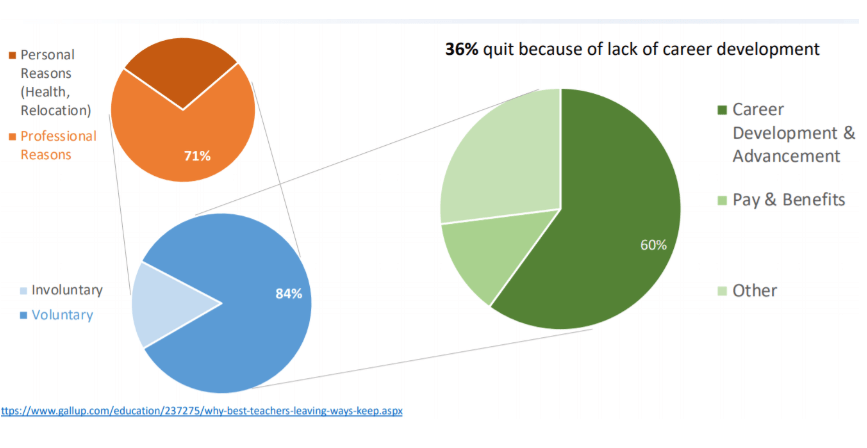
  • 36% who quit, do so because they feel no career development opportunities exist for themselves.
trends in teacher turnover why do teachers quit


Of course, with a total workforce nearing 4 million, it’s natural to see a large number of people quitting any job. However, the fact that so many, almost 300,000 teachers, are leaving the profession primarily because they see no opportunity for professional growth is troubling.

These trends are worrisome enough, but become even more worrisome when coupled with some additional statistics about the next generation of teachers.

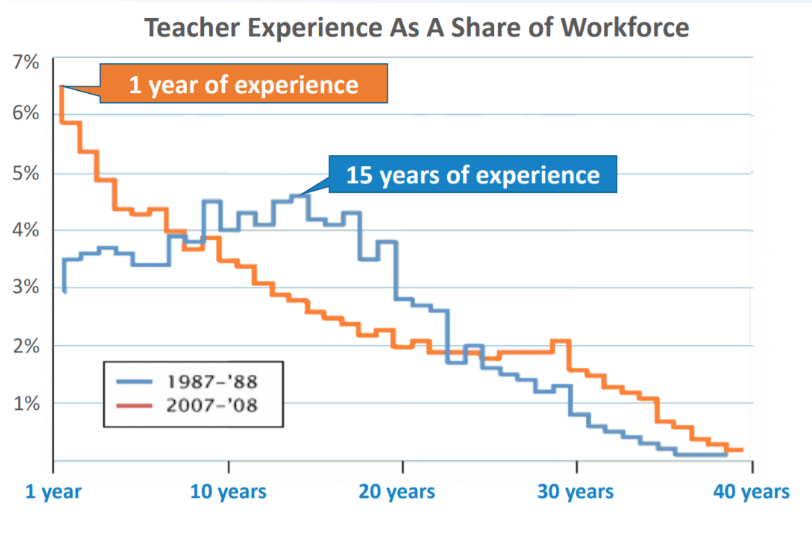
The average teacher has fewer years of experience in the profession than they have in decades.

teacher experience as a share of the workforce


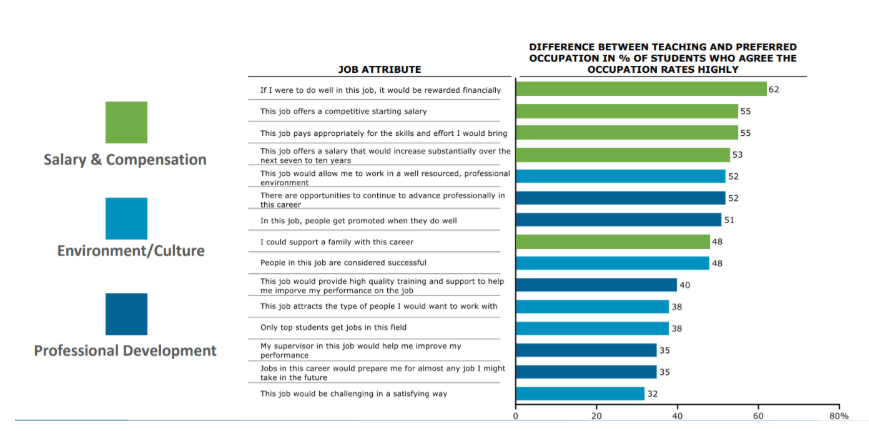
Teaching as a profession is not popular to young Americans considering their future careers.

how popular is teaching


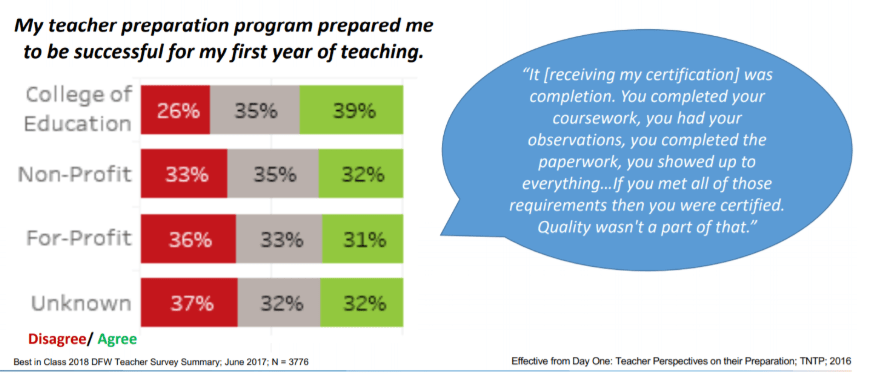
And 2/3rds of those who do pursue careers in teaching feel they are unprepared to do their job.

do teachers feel prepared


This is a perfect storm. The confluence of a growing population of disaffected teachers and a shrinking population of young people who are excited about and prepared for a life of teaching has two major consequences for schools:

  1. The teacher shortage is going to grow dramatically. In fact, the Department of Education has estimated that the shortage will be in the hundreds of thousands by 2025. That’s hundreds of thousands of classrooms with no certified teacher in them. That’s millions of students crammed into already overcrowded classrooms. That’s hundreds of thousands of already overworked and disaffected teachers picking up the slack.
  2. The professional growth opportunities schools provide will become even more important. As more and more people choose an alternative path to teaching, many set foot in a classroom on day one with little formal training and no practical experience at all. This means that the fundamentals of teaching, a job previously relegated to universities and other teacher preparation programs, will now fall to schools.
teacher supply and demand


So here’s the crisis: many teachers feel they are either unprepared or have little opportunity to develop new skills. Those who do feel they have learned new skills see no chance to be rewarded for those new skills. And they leave. Or, sometimes worse, they stay…unskilled and disaffected. The consequence is dire: we risk children being taught by people who don’t know how to do their jobs, are disgruntled about their jobs, or both.

And at the center of all of this is one part of education that gets, for the most part, a cursory glance and rhetorical support from most school leaders: teacher professional development.

And what do most schools do about it? They wring their hands and develop more of the same kinds of PD that they had before! Schools develop a larger quantity of one-time workshops that are measured only by attendance, they try to make PD workshops “fun” for teachers, they pay more consultants to come in and do large one-size-fits-few events, they change the name of department or grade level meetings to “Professional Learning Communities” with no substantive changes to the content. What don’t they do to develop teachers? Look to their most important asset: their teachers.

Much the same way that students should be at the center of all lesson planning, teachers should stand at the center of all professional development efforts in a school or school district. Not hypothetically, but actually. Teacher skill data should inform all planning. And the actual teacher expertise of any organization should be the locus for all support. All teachers do something well, and no teacher does everything well. By building opportunities for teachers to connect with one another in small groups based on their needs and strengths, share with one another, and be rewarded for that sharing, schools will give teachers a chance to grow and feel a sense of validation for that growth (rather than the silly certificate of attendance that arrives at the end of most workshops). There’s plenty of money for it. Schools spend hundreds of thousands of dollars on consultants and PD presenters each year. A simple reallocation of funds can distribute those dollars to teachers who contribute to their own and others’ learning. Some innovative schools are doing this already. And many teachers are as well. Entire ecosystems like Teachers Pay Teachers have sprung up to fill this void left by the institutions who are actually tasked with supporting teachers. Rather than leave these ecosystems to chance, schools should invest in them internally so teachers see an institutional recognition of their needs and growth.

Will this solve everything facing the coming crisis in the teacher workforce? Probably not. But is it better than what most schools are doing today? Absolutely.


Bias in School Discipline

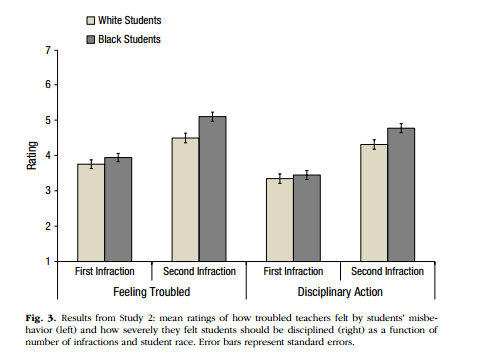
A recent study from Stanford University took pains to empirically prove that there is a significant bias among teachers when disciplining students from diverse racial backgrounds. The study, performed by Jason Okonofua and Jennifer L Eberhardt and chronicled in the journal Psychological Science, tracked discipline responses from 57 current teachers based on fabricated discipline referrals.

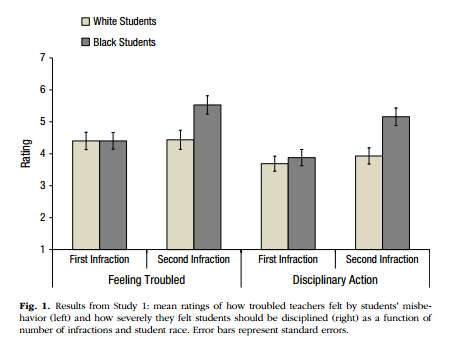
In the study, teachers were randomly given reports of student misbehavior and asked to rate the child as “troubled.” In a second experiment, the teachers were asked to decide whether to suspend the student from school based on their behavior.

Each report was assigned to a student name that would artificially assign the student a race. According to the author, “We manipulated student race by using stereotypically Black (Darnell or Deshawn) or White (Greg or Jake) names.” After receiving the discipline report, teachers were asked, “How severe was the student’s misbehavior? To what extent is the student hindering you from maintaining order in your class? How irritated do you feel by the student? and How severely should the student be disciplined?”

Initially, there was little difference between students who had stereotypical White names and stereotypical Black names. However, when teachers were presented with a second discipline report with the same name from each student, they were much more likely to believe the student identified as Black to be “troubled” and were even more likely to suspend the student from school.

study 1 TWO STRIKES Study 2 TWO STRIKES

As educators, we have a responsibility to take a hard look at our implicit bias and do what needs to be done to eliminate them.

This study provides further evidence to support a long-held belief, that a student’s race can play a significant role in how they are treated in school. Minority children are exponentially more likely to receive discipline consequences and be suspended from school for misbehavior than their White classmates. This study helps to prove that this problem has little to do with actual levels of misbehavior, and much more to do with inherent bias among educators.

The solution is certainly not simple. One significant step would be to rethink school discipline in general. Perhaps all children, regardless of race, should spend less time “in trouble” and more time figuring out how to function within their community (i.e. the school). This would require teachers and administrators to stop slamming kids with meaningless detentions, suspensions, and other disciplinary measures and replace it with a system of restorative justice and reconciliation designed to integrate kids into the classroom, rather than remove them from it.

This is hard work. But it needs to be done. The current study adds to a growing body of evidence that minority children (whether they be minorities of ethnicity, gender, sexual preference, religion or economic status) face a cornucopia of challenges each day when they walk on campus. The bias of people tasked with caring for and educating them should not be one of these challenges. As educators, we have a responsibility to take a hard look at our implicit bias and do what needs to be done to eliminate them. This will do more than just help our schools, it will help to quell the rampant school to prison pipeline in our country. Again, to quote the authors,

“Racial disparities in discipline are particular problematic because they contribute to the racial-achievement gap, increase the likelihood that Black students will drop out of school, and may then increase the probability that such youths will be incarcerated.”

Too often, we get bogged down with the challenges our students create in our classroom. Rarely to we take the time in those moments to consider the challenges these same children bring with them to our classroom. Perhaps if we did, we could stop labeling kids, and start helping them.


For more on this study,

Psychological Science. Okonofua, Jason A and Jennifer Eberhardt; Two Strikes: Race and the Disciplining of Young Students. May 2015. Vol. 26(5) 617-624.

Learning to Listen. Listening to Learn.

Children singing

I was poking around an old collection of NPR Ed Blogs that I found interesting and came across this article on Language cognition. To read the full reporting click here.

In the report, Cory Turner explores the work of the Harmony Project, an organization that works with low-income schools in the Los Angeles area to provide music education to the community’s children.

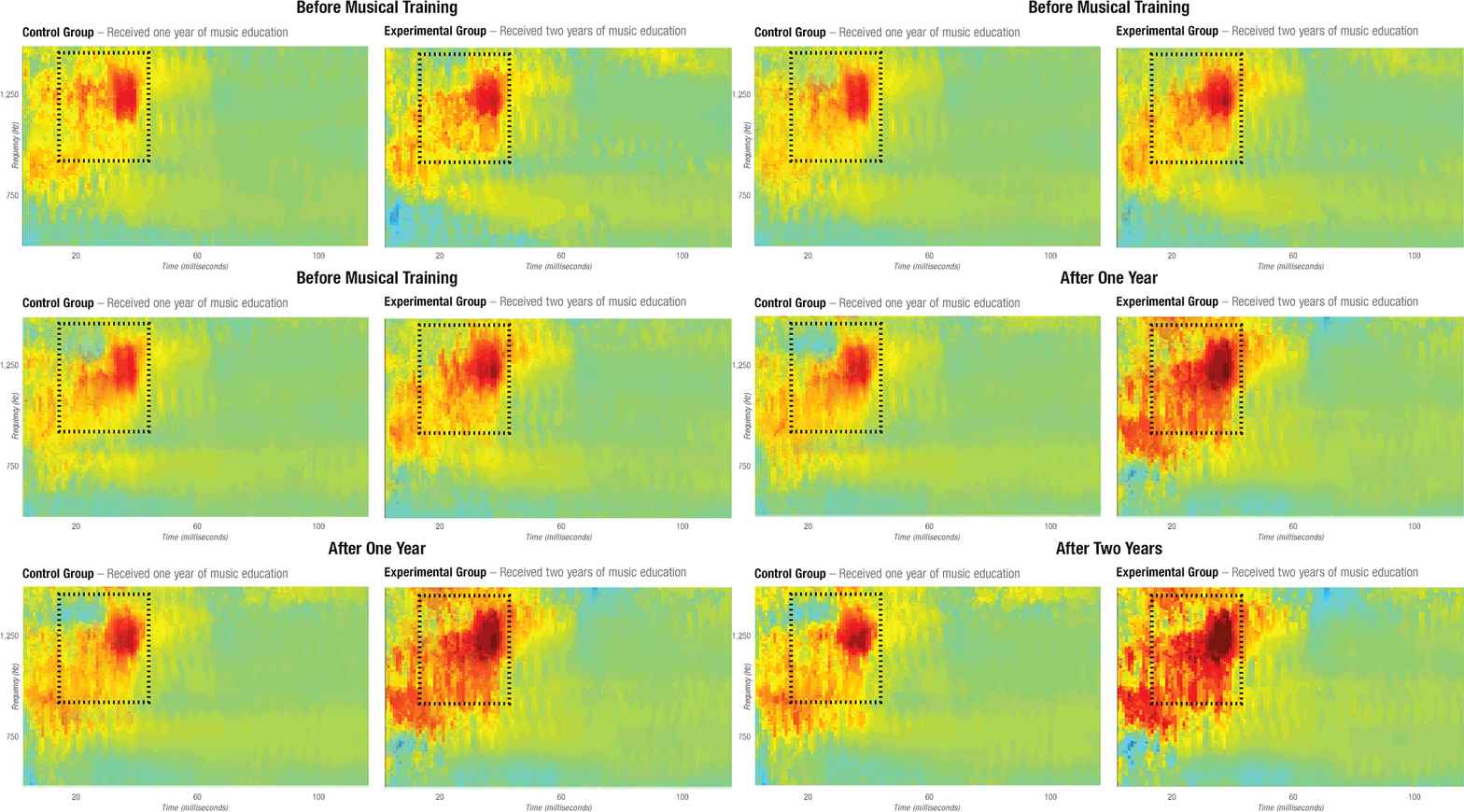
Very few people would deny the value of adding music instruction to a person’s day. For years, people have linked music instruction to all sorts of brain goodies: math skills, test scores, attendance rates, you name it. This one struck me as particularly important, though. Nina Kraus at Northwestern University studied participants in the Harmony Project to analyze their brain activity. In the study, she identifies that students from low-income communities often hear fewer words by the age of 5 than their wealthier peers. As a result, some kids enter into school unable to differentiate between language and other noise as clearly as their classmates, making it more difficult to understand instruction and communicate.

Kraus found that students in music classes provided by the Harmony Project were closing this gap. Kids who make music develop the ability to categorize pitch, timbre, and timing. While these skills are important to good music performance, they are crucial to understanding speech sounds as well. Kraus found that, as students developed musically, they also learned to block out “neural noise” that hindered their ability to learn and communicate.

Credit: LA Johnson and Alyson Hurt/NPR

Credit: LA Johnson and Alyson Hurt/NPR

This neural noise is the equivalent of hearing static or white noise…all the time. This has to be incredibly distracting and would certainly explain why some kids are harder to reach. Kids with active parents hear and participate in speech sounds, singing sounds, and experimenting with their voices, which leads to an acute ability to identify and block out neural noise in early childhood. To ensure that all students develop this skill, every kid needs the benefit of this seemingly “silly” playtime. Where better to do that than in a music class?

The more I read about kids who are “behavior problems,” the more I believe they need access to joy and beauty far more than they need rules and structure (although the latter are important too). I’m glad to see that this belief is supported by real brain science that proves it will help them develop cognitively as well as personally. Let’s spend less time trying to subjugate kids into quiet compliance, and more time encouraging them to make a joyful noise!

Learning to See without Eyes

ted2015_031415__2rl1037

Daniel Kish on his way to speak to a TED audience about reaching new possibilities

I was listening to a TED talk from Daniel Kish, a man who, by his 2nd birthday, had lost both of his eyes to cancer. Mr. Kish describes in the talk how he has learned to use a variety of techniques, including echolocation, to paint rich landscapes in his mind’s eye and, in a sense, see the world around him. He now teaches these techniques across the globe and is changing the lives of many blind people.

I suggest you take the time to watch the talk in its entirety. He’s a remarkable human being.

Daniel Kish: How I use sonar to navigate the world

Early in the talk, Daniel speaks of his first days of blindness. While still in his hospital nursery, he climbed out of his crib and began to stumble around the room. “Wandering around the nursery without eyes,” he states, “was not a problem to me. The problem was getting caught.” He would soon learn that adults would try to protect him from the dangers of the world around him.

Kish speaks about the early role of fear in his life. He speaks to the common misconception that “blindness is thought to epitomize ignorance.” I believe we often make the mistake of thinking people who are “handicapped” in some way are less able to conceive of the world as we do, or at the very least to navigate it. We treat difference as something to be feared and avoided. Fear and ignorance were powerful forces in the lives of the people who surrounded this blind baby. Fear and ignorance are powerful forces in all of our lives. Amazingly, as is often the case of people who take on the world differently, Daniel Kish sees things in another light. And he sees things quite clearly.

He credits his earliest teachers with helping him gain this perspective.

“Fortunately for me, my parents knew ignorance and fear were but matters of the mind. And the mind was adaptable.”

Matters of the mind. What poetic thought: That we can simply change our minds and be freed from our fear and ignorance. Too often we are trapped by the idea of “truth.” To be blind is a fact. It seems immutable to so many of us. And yet, to this little family, it was simply a challenge to be faced. He goes on to say, “they knew the difference between love and fear.” He describes a childhood where his parents pushed him, rather than protecting him. He speaks of parenting that fosters bravery, rather than accepting limits. To Daniel’s parents, “love” meant teaching their sightless child to walk his own path, and set his own course. And to quite remarkable effect.

“Fear,” Kish says, “immobilizes us in the face of challenges.” We have a biological predisposition to self-preservation. This is often driven by fear and a desire to remain “safe.” Most species combat this trait with a laissez faire parenting style…pushing the birds out of the nest quickly so they learn to fly. Humans, for the most part, feel compelled to “protect” our young from the dangers of the world. Often, this continues through early childhood into school, where many teachers encourage students to find the “right” answer, rather than exploring new answers. Unless something has been “proven,” it has little merit in the education system. We see that in a world where a student’s ticket out of high school is based on her ability to get the “right” answers to a test, instead of her ability to find a solution to a challenge that is innovative and unique.

If we want to see what works in the modern world, we have to look to people like Daniel Kish. Rather than letting fear back him into a dark and sightless world, Daniel learned to use his other senses, including the often-ignored “sense of imagination,” to see the world in a way that we could never conceive. Along the way, I’m sure he stumbled more than once. I’m sure he got the answers wrong a few times. Most great people do. What makes Kish most remarkable, however, was that he did not let fear define him. With the help of adults who showed him what real love meant, he chose his strengths over his limitations, and found new ways to see the world. This is learning at its best. It’s amazing what you can learn when you are taught not to be afraid of making the wrong choice, but rather to see the unlimited choices that lay before us.

Is it really a choice?

As an educator, I believe school choice is a powerful tool worthy of consideration. However, the discussion ignores an under served population of Texas kids whose families lack the time and/or resources to research private or charter schools.

If the Legislature wishes to provide free and equal access to education for all students in Texas, they must find a way to ensure that every school receives the support it needs to help kids succeed.

School choice might not create a mass exodus public schools, but what if it does? Well-supported students will attend the school they choose, while many public schools will serve students who need the most, but receive the least. Without safeguards to protect public education, Texas will head down a path to schools that are separate, but not equal.

The company behind “All Those Tests”

ba00862.jpg

In an extensive article in Politico, Stephanie Simon explores the vast influence of Pearson-a private sector corporation based in London- on the American education system.

For the full article click here.

There has been a great debate in our country over the past 20 years on the role of standardized testing in this country. It is perhaps the most divisive issue in education policy today. Many critique high-stakes standardized for wrenching control of the classroom from local campuses and teachers. Others claim that a standardized test is important to ensure quality instruction on all campuses. The truth probably lies somewhere between these two arguments. However, one thing is sure: the policy decisions are being made by a decreasing number of stakeholders. Chief among these are the executives of Pearson, who strategically aligned themselves to have vast influence on assessment and instruction, in addition to teacher training and accountability.

“The genius of Pearson is the interconnection among their markets…That gives Pearson its power.”

According to Simon:

“To prepare their students for Pearson exams, districts can buy Pearson textbooks, Pearson workbooks and Pearson test prep, such as a suite of software that includes 60,000 sample exam questions. They can connect kids to Pearson’s online tutoring service or hire Pearson consultants to coach their teachers. Pearson also sells software to evaluate teachers and recommend Pearson professional development classes to those who rate poorly — perhaps because their students aren’t faring well on Pearson tests.

‘The genius of Pearson is the interconnection among their markets,’ said (Michael) Apple, the education policy professor(at the University of Wisconsin-Madison). ‘That gives Pearson its power.’”

A great deal of Pearson’s power is the size of the company. Founded in 1844 as a construction firm, Pearson has grown to an international conglomerate with interests in education, news media, publishing, and entertainment. They own such well-known brands as Penguin Random House publishing, Madame Tussauds wax museum, and the quiz-show “Family Feud.” The company’s bread and butter comes from American schools, though. Pearson’s international profits for education alone exceeded $1 billion. 55% of that came from its North American education division. While much of that money goes into research and development, Pearson maintains a massive lobbying effort, both in Washington and in local state houses. Some estimates show that Pearson’s non-profit division spent $1 million in Texas alone lobbying law makers.

The size of the company combined with its lobbying interests have afforded it the power to earn No-Bid contracts, both at the district and state levels. The brands represented by Pearson (and many of its subsidiaries) have become so ubiquitous with assessment and instruction that many lawmakers do not give a second thought to using them as their sole-source provider. Many critique this monopoly as the reason standardized testing has been largely inefficient and ineffective. However this trend seems to be changing.

Again, Simon says:

“[A] big blow came this fall in the Lone Star State when Education Commissioner Michael Williams declined to renew Pearson’s $90 million-a-year contract to run the Texas standardized testing program.

The state auditor had ripped into the contract in a 2013 report that concluded it was far too vague to allow for effective oversight by the Texas Education Agency. The contract had so few details about the costs of each element that when the legislature eliminated 10 of the 15 tests required for high school graduation, state officials had to rely on Pearson to tell them how much they’d save.

Texas launched a competitive bidding process for new exams and is now reviewing the proposals.”

This will have a major impact on the future of assessment in our state. If other companies are allowed the opportunity to provide services to local ISDs and state assessments, the market will drive improvement. Perhaps Pearson will continue to be the best. But some competition is just what Texas needs to keep this massive company honest, and make sure they are doing what’s best for our students, and not what’s best for their bottom line.

For too long, “these tests” have borne the brunt of the criticism. This critique ignores the bigger picture and the value of testing in the school system. Assessment is a valuable tool for ensuring student success across geographic and socio-economic strata. It is also important as a formative tool for knowing what goals to set for classroom learning. However, when one company monopolizes control over an industry, innovation suffers.

Local campuses and districts need to be able to find resources that will work for their teachers and students. Much of those resources can be developed by the teachers and administrators themselves. And when districts need to outsource some of the work, there needs to be room for small upstarts to develop useful and innovative content. Of course, all of this needs money. The answer lies in where state legislatures allocate funds. As Texas moves forward into a new budgetary biennium, Texans need to encourage our lawmakers to move funding away from a major foreign corporate interest, and toward the wellbeing of Texas schools, Texas Teachers, and Texas children.

What the President’s Budget Says about American Education

Barack Obama

The Presidential Budget for 2015 says a great deal about President Obama’s priorities for the future of our country. As a part of a broader theme on Middle Class Economics, he devoted a significant portion of the budget to Education reform. For the full text on the President’s requests for education funding, click HERE.

Here are the bullet points:

  • $750 Million for Preschool Development Grants and a $1.5 Billion increase for Head Start Funding-both initiatives would dramatically increase funding to provide quality education to all American children as young as 3 years old.
  • $1.1 Billion increase to Title 1 Funding for low-income schools that use the money for evidence-based improvements to student outcomes.
  • $11.7 Billion for Special Education Services
  • $773 Million to provide services for English Language Learners
  • $8 Billion in funds to help recruit, train, and retain high-quality teachers.
  • $556 Million in School Improvement Grants and $125 Million in funding to develop New School Models that enact evidence-based reforms and reimagine American High Schools.
  • $375 Million in Charter School Funding
  • $300 Million in funding for research on innovation and effective practices in education.
  • And, of course, free Community College for all Americans.

This whopping sum of money might seem astronomical, but is actually a relatively small portion of the federal budget. Of course, very little of this funding will ever see the light of day. But that was never the point, was it?

I was re-watching an old episode of The West Wing the other night in which Alan Alda, who plays a Republican candidate for president, is speaking to a democratic White House staffer. He talks about the fact that the framers of the Constitution never intended for members of the United States government to trust one another. This is why they invented the system of checks and balances. The branches of government are designed to keep us from getting along and agreeing on everything. He argues that this piece of history has been the bedrock of our Nation’s strength, and I tend to agree.

If I had my way, every dime of this funding would get minted tomorrow. Of course, if I had my way, the federal government would go broke. Even if the wealthiest Americans and our Corporate partners footed their fair share of the bill (which they should), there will never be enough money to help everyone Democrats want to help. And even if there was, a Republican congress would never let us spend it all. And that’s OK. We need to have a push and pull on government spending. It’s good that no single person gets to say where we spend our money, and what our national priorities are. A legislative body that marches lockstep with one another will likely fall, like lemmings, off a cliff. The process allows room for productive debate. This Budget puts education at the forefront of that debate.

President Obama has spent much of his presidency fighting for broader access to opportunity. How that is enacted is anybody’s guess, but I think it’s a noble pursuit nonetheless. His 2015 Budget isn’t a line-item report, but rather a list of priorities to put America to work for Americans. What I see when I read his funding requests for education is a prescient point.

In the State of the Union, President Obama pointed out that, for the first time in a century (at least), a generation of Americans will not receive more education than their parents. Coupled with consistent rhetoric from employers that the incoming workforce lacks the skills and ethic they need to be productive in 21st century jobs, we see a crucial priority for our country. The way we educate our Nation’s youth isn’t working, We need to do more.

Schools will likely not see much of the money President Obama requested for education. American’s will likely not receive a free and compulsory education that extends far beyond their 18th birthday anytime soon. But we can look at ways to change the system. We can find opportunities to innovate instruction, broaden access, and deepen knowledge right now. This is how we will show state and national legislators that schools are worth the investment. Clearly, Americans are primed for a conversation on getting schools to work again. As educators, our first priority should be to get to work on schools that actually do work. The money will follow!

Public Education’s Poor Majority

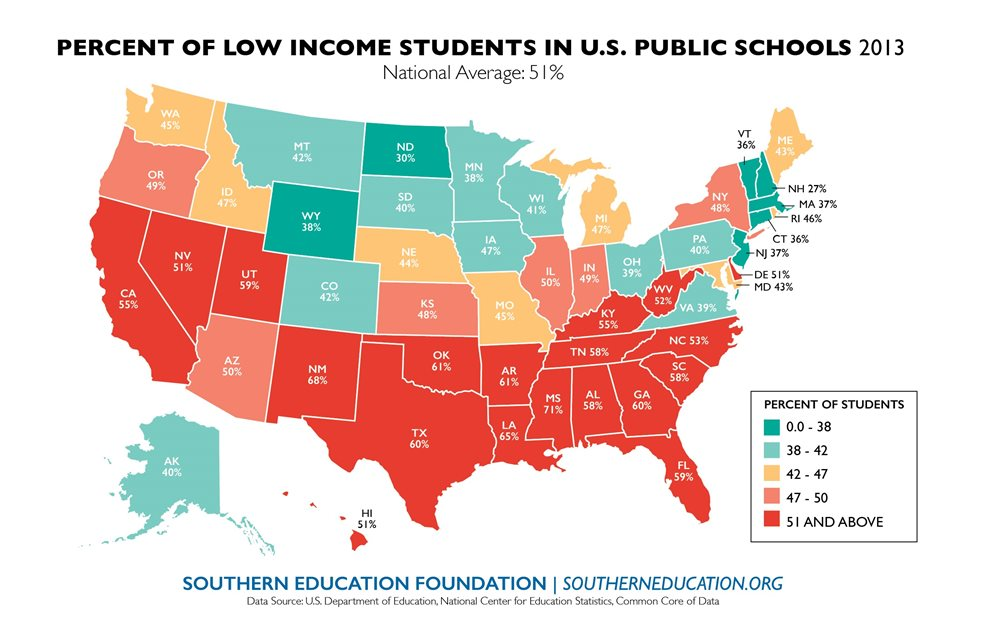
A recent study by the Southern Education Foundation  suggests a hard reality for American public schools. According to a U.S. Department of Education survey of Free And Reduced lunch statistics, more than half of American public school students now live below the poverty line. This troubling reality is more significant in Texas, who ranks 6th in the nation in student poverty, with 60% of Texas kids coming from impoverished households.

Percentage of Low Income Students by state 2013

The study also suggests that American’s must reconsider previously held beliefs about the geographic reality of poverty. No longer can suburban school districts pretend to ignore this issue. The misconception that poor students are solely the responsibility of rural and inner-city schools is simply not true. According to Steve Suitts, the Foundation’s Vice president, “Even in the suburbs, low-income students are now 40% of the student population in the public schools…It’s everyone’s problem.”

Without improving the educational support that the nation provides its low income students – students with the largest needs and usually with the least support — the trends of the last decade will be prologue for a nation not at risk, but a nation in decline

“A New Majority: Low Income Students in the South and Nation. The Southern Education Foundation (2013)

This is an important statistic for educators to consider, as low-income students often require a more expensive education than their wealthier peers. Schools who service impoverished learners must account for the obvious gaps in resources. However, we must also consider the needs of kids who will not benefit of after school enrichment, summer camps, and families with the time and resources to help students grow at home. Most families want for their kids to learn and grow, but many do not have the time or money to give that desire a backbone. This is where schools have to pick up the baton.

As the Texas Legislature considers important school funding bills for the next biennium, it is imperative that they take into account the needs our State’s kids. Educators will need greater resources to provide for the new majority in Texas public schools. “Doing more with less” is simply not an option. The “more” these kids need is far too great to ignore and de-fund. If Texas lawmakers believe that our children are, in fact, an important resource for our State’s future, they simply must put their money where their mouth is.

Additionally, schools need flexibility with this funding to provide kids with services that might not have traditionally been within the scope of public education. Innovate teachers across the state will take the initiative to give all Texas kids what they need, but they need the time and money to make it happen. They also need the flexibility to do what’s best for their students and their community. School funding structures need to allow for this flexibility so campuses can make the important decisions they need to create school days that best serve the growing population of learner/breadwinners that go to school and support their families.

This issue is not just a political issue, it is a central economic reality for our State and our Nation. The strength of our National economy is dependent on the next generation of learners. The Foundation’s report says it best. “No longer can we consider the problems and needs of low income students simply a matter of fairness…Their success or failure in the public schools will determine the entire body of human capital and educational potential that the nation will possess in the future. Without improving the educational support that the nation provides its low income students – students with the largest needs and usually with the least support — the trends of the last decade will be prologue for a nation not at risk, but a
nation in decline”

No longer can we consider the problems and needs of low income students simply a matter of fairness…Their success or failure in the public schools will determine the entire body of human capital and educational potential that the nation will possess in the future.

“A New Majority: Low Income Students in the South and Nation. The Southern Education Foundation (2013)

Just a thought

Some days are a stark reminder that many of our Nation’s children come to school burdened by much more than school books and homework. Today was one of those days.

We owe our children everything, America.

Everything.

We owe them the chance to use their education to lessen the burden of poverty. We owe them the chance to become inspired to greatness. We owe them every ounce of today we have to give, and then a double-share more.

They will repay us with their remarkable spirit. Their recompense will be the hope they give us for tomorrow.

Give them all you’ve got. For their burden is great, but their spirit greater. And our every ounce of help may be just what these remarkable spirits need.