Uncategorized

Human Capital is a Depreciating Asset

Human Capital is a Depreciating Asset


This post was originally posted on the Sibme blog

I want you to imagine for a bit that you own a major manufacturing plant. You produce something that is vital to the health of the country. Let’s say it’s candy bars. Without your candy bars, the country would collapse. Economic output would stop, society would no longer be able to function as a whole, the government would shut down, key infrastructure would fail…chaos. These candy bars are the very life-blood of our nation. We cannot survive without these candy bars.

To produce these candy bars, you need several different pieces of equipment. And you work very hard to get the best versions of this equipment around. You shop around, you negotiate deals, you carefully ship the equipment to your manufacturing plant. And on Tuesday, all of the equipment arrives. The equipment that produces the candy bars that the country can’t live without has arrived!


Then what do you do?


Well…this equipment is important. So, of course, you gingerly set the equipment up. You hire knowledgeable people to run the equipment, you hire people to manage the people who run the equipment, you monitor the performance of the equipment. And whenever something gets worn, or something breaks, you immediately bring someone in to maintain it. That’s what any thoughtful candybar mogul would do, right? After all, this equipment is vital to the success of your company, and to the health of the country. 


Throughout the life of this equipment, the manufacturer might offer you upgrades on the equipment. Sometimes those upgrades are unnecessary and you might choose to avoid them. But you will consider each product update to make sure that your equipment is the best it can be. 


And regularly, perhaps even monthly, you’ll work carefully to maintain that equipment. You’ll oil it’s gears, you’ll make sure it’s nuts and bolts are all tightened. You’ll even hire people to come in and provide regularly scheduled maintenance to keep things running smoothly. 


You’re a good and honest steward of your company. You do well to invest resources, time, and money in the maintenance of your equipment. That’s because you understand one of the fundamental rules of Economics: capital depreciation. 


Of course, all of the resources you use to make your candy bars are capital. But this machinery is the most important kind of capital. In case it’s been a few weeks since your last Economics course, capital is any asset you use to produce goods. All capital has value, and different types of capital have different worth to different people or companies. But this capital. This beautiful machine that produces these vital candy bars, this machine is the most important capital to you. So it’s value is very high.


But, inevitably, the value will go down over time. This is another fundamental law of economics: depreciation. Depreciation simply means that the value of certain types of capital goes down over time. That’s because it’s ability to contribute to the production of goods becomes more costly, or it becomes more inefficient. So, this beautiful machine, which can produce 100,000 candy bars an hour on day one, will eventually produce 99,999 candy bars in an hour. As the gears get rusty, the machine runs slower, and it becomes inefficient.


So we’re back to maintenance. All assets have a valuable life, the time-span over which they can produce goods in a cost-effective and efficient manner. There will come a day where the machine will seize up, the gears will no longer turn, and the number of candy bars it can produce will go to zero. And you’ll have to replace it. It will no longer be valuable capital. But your goal, as a prudent businesswoman, is to cast that fateful day as far into the future as possible–at least as long as it’s cost-effective to do so. That’s why we take our cars to get the oil change. And we clean out the lint traps on our driers. And we clean the oven once every…well…ten years if you’re like me. We want to prolong the life of our assets. Because, up until a point, it’s cheaper to maintain the capital you’ve got than it is to acquire new capital. 

Human Capital


Of course, you don’t make candy bars. 

In fact, you may not make anything anymore. 

And maybe you don’t use much machinery. 

But you still have lots of Capital that you use. 

We have a very different kind of capital: Human Capital. 


Of course, people are very different from machines. But the people on your team and the candy bar machine have one thing in common: without them, you wouldn’t exist. So here’s the big question: do you treat your people the way you treat valuable equipment?


Every manager says they do. This article from Ethan Rouen considers the accounting ramifications of talking about people as “our most valuable asset” versus treating people like one. 


Balance sheets aside, the real question is about maintaining value. The same way that physical capital is made up of parts and components that must be maintained to prevent depreciation, all of us have components (skills, knowledge, ability) that must either be maintained or replaced. That granular approach to human capital is rare, though. Most employers think of people as a whole unit, rather than as a sum of strengths. This is a mistake. Often, the consequence is that a person, who’s skills, knowledge, and ability —which I’ll refer to as Human Capital from now on—inevitably depreciates in value over time, gets tossed aside long before their “depreciable life” is up. Any manager who throws out a piece of equipment simply because a single gear breaks would be considered foolish and wasteful. But we often look to replace people when one or two of their skills no longer “do the job.” Instead of thinking of ways to improve or replace the Human Capital, employers often just replace the human. 


The tricky thing is that you can look in a catalog, see how much a new computer costs, and see how much it would cost to replace your existing computer’s CPU or upgrade it’s memory. That allows you to make a simple calculation to decide what’s more efficient. The hidden cost of hiring a new person versus “upgrading” the Human capital of your existing team is much more difficult to quantify. But it’s not impossible. The Work Institute estimates that it costs as much as 33% of an employee’s salary to replace them. So unless you can hire someone else at ⅔ the cost of your current employee, it’s probably worth considering how you can keep their Human Capital from depreciating rather than just kicking them to the curb for a shiny new person. And there are a host of other hidden costs. When people start getting fired, workplace productivity is affected by gossip, changes in morale, and the added cost of interviewing, on boarding, and enculturating their replacement. 


So if it’s costly to replace human capital, and maintenance is the better option in most cases, who’s supposed to do the maintenance? Many employers might tacitly say that they want to invest in their most “valuable asset” but then turn around and say the best solution is to “hire right.” Hiring right is like buying a shiny new machine. It’ll be great for a while, but everyone’s human capital depreciates over time. And still, how do you even know that the person you hire even has the human capital you need? 

So, you’ve got these people. And hopefully by now you’re convinced that you need to invest in keeping them from depreciating. But how do you do it?


Most employers approach this in one of two ways:


  1. “It’s their problem not mine.” Performance reviews look like this. Often, The review does little more than tell the employee what they’re doing wrong. Imagine the same situation with a piece of physical capital? Would you just tell a machine what’s wrong with it and expect it to fix itself? Of course not! Of course, people are smarter than machines. One of our strengths is our ability to learn on our own. But most of the time, even that isn’t enough. 
  2. Ineffective solutions. Many employers go so far as to seek out —and invest small fortunes in—potential solutions to the problem. They purchase books, virtual curriculums and “how to” videos to show their employees what effective Human Capital is. Or perhaps they’ll go so far as to gather a bunch of people in a room for an afternoon and hire a consultant to come in and tell them what effectiveness is. At best, these solutions are ineffective, and more commonly, they’re worthless, costly, and time-consuming. Consider again our Candy Machine. Would you let the machine watch a newer machine, or would you bring in a mechanic and have them just TALK to you about how the machine SHOULD be running? I hope not. That would be a huge waste of money. Again, yes, people aren’t machines. But there’s tons of research that information sharing is only the starting line, not the finish line. Everyone who wants to improve knows that there’s only one way to get to Carnegie Hall: practice. If you brought in a mechanic, you wouldn’t pay them a cent to sit in your office and tell you what your machine should be doing. You’d insist that they get to work—oiling gears, taking out the parts that have worn out and putting in new components. If you hire a consultant and they don’t do the exact same thing with your human capital, send them packing. (And, really, you probably shouldn’t hire them in the first place, they rarely have the time it takes to do the actual work necessary to help your team hone their skills and practice new ones to replace their outdated human capital.)


Instead of wasting valuable time and money on these insufficient and ineffective solutions, individuals and teams need to work collectively to keep human capital from depreciating systematically. Really, the work falls into three steps:

Human Capital Components


Look at the “parts” you need

Every organization produces something. It might not be candy bars–It might be car parts or students who know how to solve quadratic equations–but if you’re not producing something that’s valuable, you wouldn’t exist. And producing those things requires certain capital, both physical and human. So the first step is to look at what you produce, or what you’d like to produce, and see what capital you need to produce it. Creating and maintaining an inventory is the first step to knowing where you’re going. Organizations skip this step too often. They look at “the products” they want to produce, but they give little more than a glance at what it takes to actually produce them . I don’t know anything about candy bars or cars, but I know about teachers, and I’ve seen this step skipped many times in learning organizations. Saying “we have 300 students that need to learn the quadratic equation, so we need 10 math teachers” is not nearly enough to accurately identify your “capital requirements” to achieve your “product.” What does it take for your 300 students to learn quadratic equations? What human capital do the 10 teachers need to be effective? That’s the important work. 


Look at the “parts” you’ve got

For many organizations, the closest anyone gets to addressing human capital depreciation is a performance review. Done properly, performance reviews can be a helpful part of the process, but they are only part of the process. Only after completing an accurate inventory of what the organization needs should you consider performance reviews of any kind. The idea of reviewing a person’s performance should only be connected to the human capital required in your organization. Right next to your inventory of “required parts” from step one should be a way of tracking who’s got the human capital you need, who’s human capital needs to be refreshed, and what human capital each person needs to set aside to make room for new human capital. This will help you plan collaboratively to martial meaningful resources to keep your human capital up to date. 


Get to work maintaining

Once you’ve got an idea as to what needs to be oiled, what needs to be removed, and what needs to be replaced to keep your human capital in tip-top shape, start doing it. Don’t hire the mechanic first, your organization is made up of mechanics! Pair people in iterative relationships so they can help one another maintain collective human capital. Everybody does something well, and nobody does everything well. Devote time and energy to this work. Don’t just do it once a quarter. Parts can get wobbly if left alone for too long. You need people to work together everyday to keep things running smoothly. 


A note about hiring outsiders to help with this process: When you bring in an outsider to maintain your human capital, it is the least efficient solution. There’s no way they’ve gone through steps 1 & 2 with you, so even if they’re experts in quadratic equations, they don’t know your people as intimately as you do. So be careful when bringing them in. If you manage a sales team and you hire a consultant, don’t tell the consultant “I need better sales people.” You’ll get nothing but an expensive consulting invoice in return. Be specific when hiring a contractor, and monitor their work closely to make sure they’re fixing the problem you want fixed. 


Human Capital InvestmentThese three steps must be embedded in the culture of your organization. Measure it, talk about it, devote time and energy to it, and when somebody does the hard work of refreshing their human capital, reward it!!!! After all, they’ve saved you tons of money by not making you hire someone new to replace them. 


People often think of the process of building and maintaining human capital when they aren’t in the workforce. It’s a mistake to believe that we spend the first twenty or so years of our lives “building the machine” and then put it to work. The only thing that happens when we leave the education stage of our lives and enter the workforce, for most people, is that we stop the much-needed maintenance work. But that doesn’t mean we start depreciating at that moment. In actuality, when we enter the workforce and stop learning, depreciation doesn’t start, it accelerates. So then we become obsolete more quickly, and only then do we think about gaining new human capital. Don’t do that. Organizations, and the people inside of them, only survive when everyone learns everyday. And do the hard work at looking at your human capital and deciding what needs to be removed to make room for new parts. This problem exists in every sector of the job market. Some estimates indicate that there will be a shortage of 85 million people in the workforce by the year 2030. That’s not for a lack of humans…it’s for a lack of human capital. It’s up to all of us to solve that problem, both as individuals and as organizations. Nobody’s going to solve it for us!

The Coming Crisis in Education

Schools and school leaders spend a lot of time thinking about many crises in education, but many of them focus on student trends: test scores, changing demographics, declining literacy rates and the like. But there’s another crisis that few people on campuses around the country focus on: changes in the teacher workforce. Ignoring this crisis is to the peril of students in all schools. As these changes continue to grow—and they will continue to grow—the negative impact on classrooms will become more apparent than it already is today.

In an October 2019 presentation to the Consortium of State Organizations for Texas Teacher Education (CSOTTE), the Texas Education Commissioner Mike Morath shared some troubling statistics about workforce trends among Texas’ teachers. It’s always dangerous to extrapolate national trends from Statewide data, but similar trends have been cited by researchers at universities around the country and even the US Department of Education.

The most troubling statistics?

  • 1 million teachers quit every year
  • A growing number of those teachers aren’t quitting to go work at another school; they’re quitting teaching altogether.
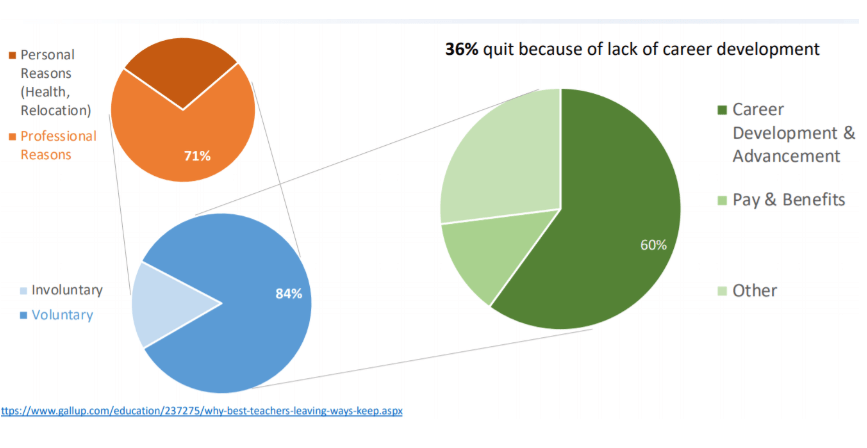
  • 36% who quit, do so because they feel no career development opportunities exist for themselves.
trends in teacher turnover why do teachers quit


Of course, with a total workforce nearing 4 million, it’s natural to see a large number of people quitting any job. However, the fact that so many, almost 300,000 teachers, are leaving the profession primarily because they see no opportunity for professional growth is troubling.

These trends are worrisome enough, but become even more worrisome when coupled with some additional statistics about the next generation of teachers.

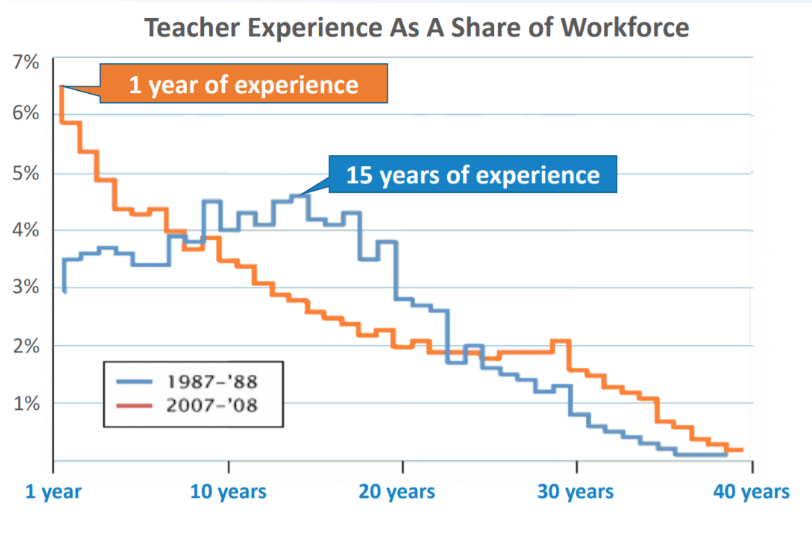
The average teacher has fewer years of experience in the profession than they have in decades.

teacher experience as a share of the workforce


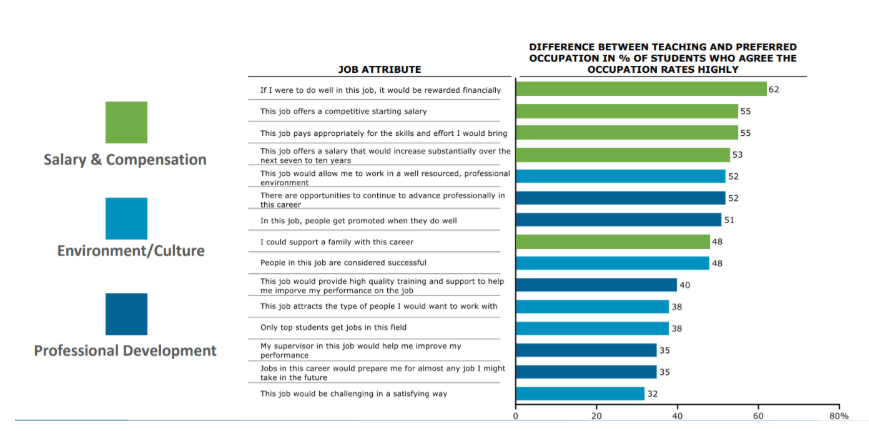
Teaching as a profession is not popular to young Americans considering their future careers.

how popular is teaching


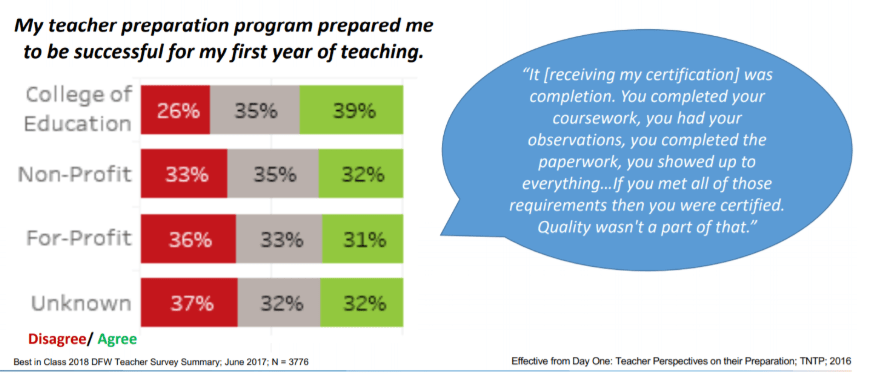
And 2/3rds of those who do pursue careers in teaching feel they are unprepared to do their job.

do teachers feel prepared


This is a perfect storm. The confluence of a growing population of disaffected teachers and a shrinking population of young people who are excited about and prepared for a life of teaching has two major consequences for schools:

  1. The teacher shortage is going to grow dramatically. In fact, the Department of Education has estimated that the shortage will be in the hundreds of thousands by 2025. That’s hundreds of thousands of classrooms with no certified teacher in them. That’s millions of students crammed into already overcrowded classrooms. That’s hundreds of thousands of already overworked and disaffected teachers picking up the slack.
  2. The professional growth opportunities schools provide will become even more important. As more and more people choose an alternative path to teaching, many set foot in a classroom on day one with little formal training and no practical experience at all. This means that the fundamentals of teaching, a job previously relegated to universities and other teacher preparation programs, will now fall to schools.
teacher supply and demand


So here’s the crisis: many teachers feel they are either unprepared or have little opportunity to develop new skills. Those who do feel they have learned new skills see no chance to be rewarded for those new skills. And they leave. Or, sometimes worse, they stay…unskilled and disaffected. The consequence is dire: we risk children being taught by people who don’t know how to do their jobs, are disgruntled about their jobs, or both.

And at the center of all of this is one part of education that gets, for the most part, a cursory glance and rhetorical support from most school leaders: teacher professional development.

And what do most schools do about it? They wring their hands and develop more of the same kinds of PD that they had before! Schools develop a larger quantity of one-time workshops that are measured only by attendance, they try to make PD workshops “fun” for teachers, they pay more consultants to come in and do large one-size-fits-few events, they change the name of department or grade level meetings to “Professional Learning Communities” with no substantive changes to the content. What don’t they do to develop teachers? Look to their most important asset: their teachers.

Much the same way that students should be at the center of all lesson planning, teachers should stand at the center of all professional development efforts in a school or school district. Not hypothetically, but actually. Teacher skill data should inform all planning. And the actual teacher expertise of any organization should be the locus for all support. All teachers do something well, and no teacher does everything well. By building opportunities for teachers to connect with one another in small groups based on their needs and strengths, share with one another, and be rewarded for that sharing, schools will give teachers a chance to grow and feel a sense of validation for that growth (rather than the silly certificate of attendance that arrives at the end of most workshops). There’s plenty of money for it. Schools spend hundreds of thousands of dollars on consultants and PD presenters each year. A simple reallocation of funds can distribute those dollars to teachers who contribute to their own and others’ learning. Some innovative schools are doing this already. And many teachers are as well. Entire ecosystems like Teachers Pay Teachers have sprung up to fill this void left by the institutions who are actually tasked with supporting teachers. Rather than leave these ecosystems to chance, schools should invest in them internally so teachers see an institutional recognition of their needs and growth.

Will this solve everything facing the coming crisis in the teacher workforce? Probably not. But is it better than what most schools are doing today? Absolutely.


Is it really a choice?

As an educator, I believe school choice is a powerful tool worthy of consideration. However, the discussion ignores an under served population of Texas kids whose families lack the time and/or resources to research private or charter schools.

If the Legislature wishes to provide free and equal access to education for all students in Texas, they must find a way to ensure that every school receives the support it needs to help kids succeed.

School choice might not create a mass exodus public schools, but what if it does? Well-supported students will attend the school they choose, while many public schools will serve students who need the most, but receive the least. Without safeguards to protect public education, Texas will head down a path to schools that are separate, but not equal.

Public Education’s Poor Majority

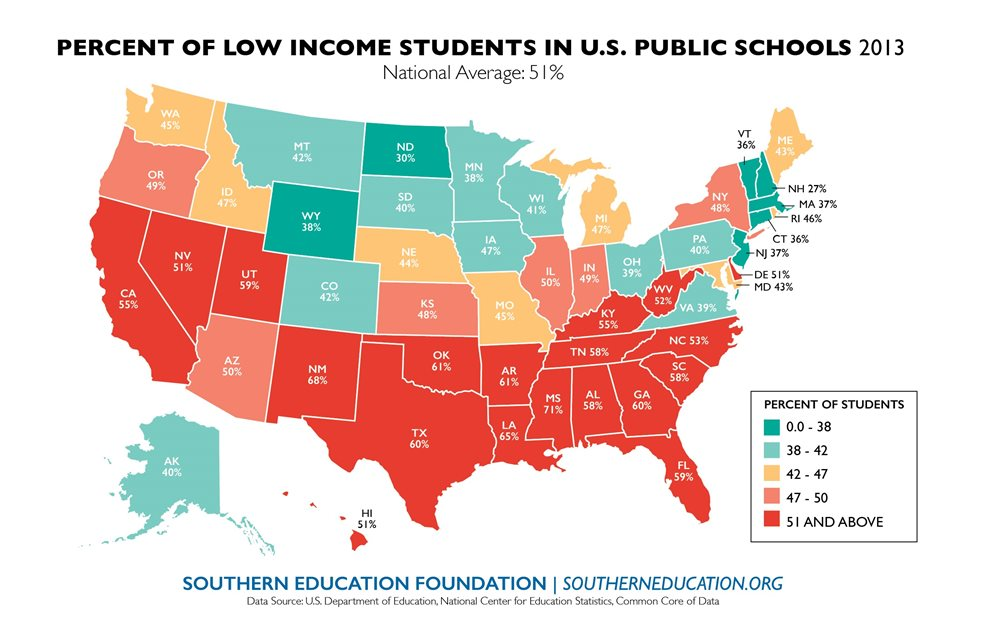
A recent study by the Southern Education Foundation  suggests a hard reality for American public schools. According to a U.S. Department of Education survey of Free And Reduced lunch statistics, more than half of American public school students now live below the poverty line. This troubling reality is more significant in Texas, who ranks 6th in the nation in student poverty, with 60% of Texas kids coming from impoverished households.

Percentage of Low Income Students by state 2013

The study also suggests that American’s must reconsider previously held beliefs about the geographic reality of poverty. No longer can suburban school districts pretend to ignore this issue. The misconception that poor students are solely the responsibility of rural and inner-city schools is simply not true. According to Steve Suitts, the Foundation’s Vice president, “Even in the suburbs, low-income students are now 40% of the student population in the public schools…It’s everyone’s problem.”

Without improving the educational support that the nation provides its low income students – students with the largest needs and usually with the least support — the trends of the last decade will be prologue for a nation not at risk, but a nation in decline

“A New Majority: Low Income Students in the South and Nation. The Southern Education Foundation (2013)

This is an important statistic for educators to consider, as low-income students often require a more expensive education than their wealthier peers. Schools who service impoverished learners must account for the obvious gaps in resources. However, we must also consider the needs of kids who will not benefit of after school enrichment, summer camps, and families with the time and resources to help students grow at home. Most families want for their kids to learn and grow, but many do not have the time or money to give that desire a backbone. This is where schools have to pick up the baton.

As the Texas Legislature considers important school funding bills for the next biennium, it is imperative that they take into account the needs our State’s kids. Educators will need greater resources to provide for the new majority in Texas public schools. “Doing more with less” is simply not an option. The “more” these kids need is far too great to ignore and de-fund. If Texas lawmakers believe that our children are, in fact, an important resource for our State’s future, they simply must put their money where their mouth is.

Additionally, schools need flexibility with this funding to provide kids with services that might not have traditionally been within the scope of public education. Innovate teachers across the state will take the initiative to give all Texas kids what they need, but they need the time and money to make it happen. They also need the flexibility to do what’s best for their students and their community. School funding structures need to allow for this flexibility so campuses can make the important decisions they need to create school days that best serve the growing population of learner/breadwinners that go to school and support their families.

This issue is not just a political issue, it is a central economic reality for our State and our Nation. The strength of our National economy is dependent on the next generation of learners. The Foundation’s report says it best. “No longer can we consider the problems and needs of low income students simply a matter of fairness…Their success or failure in the public schools will determine the entire body of human capital and educational potential that the nation will possess in the future. Without improving the educational support that the nation provides its low income students – students with the largest needs and usually with the least support — the trends of the last decade will be prologue for a nation not at risk, but a
nation in decline”

No longer can we consider the problems and needs of low income students simply a matter of fairness…Their success or failure in the public schools will determine the entire body of human capital and educational potential that the nation will possess in the future.

“A New Majority: Low Income Students in the South and Nation. The Southern Education Foundation (2013)

Just a thought

Some days are a stark reminder that many of our Nation’s children come to school burdened by much more than school books and homework. Today was one of those days.

We owe our children everything, America.

Everything.

We owe them the chance to use their education to lessen the burden of poverty. We owe them the chance to become inspired to greatness. We owe them every ounce of today we have to give, and then a double-share more.

They will repay us with their remarkable spirit. Their recompense will be the hope they give us for tomorrow.

Give them all you’ve got. For their burden is great, but their spirit greater. And our every ounce of help may be just what these remarkable spirits need.

We’re in the money?

Money for Kids

The opening bell rang on the 84th Texas State Legislature today. Amid some leadership elections, oath swearing, and box unpacking, the State Comptroller made a report on the Biennial Revenue estimate. That number, and it’s a big one, is the amount the Legislature uses to guide the direction of our State for the next two years.

And there’s good news!

For 2014-2015, the state can expect to have $101.4 billion in funds available for general-purpose spending. This represents a 12.4% increase from the corresponding amount of funds available for 2012-2013. * (italics added)

You heard it, Texas. 12.4% more money!!!! I’m not going to ask where the money came from, since I don’t really see much economic growth in the part of Texas where I spend my days. I’m just glad it came from somewhere.

But wait…there’s more.

In addition to the General Revenue-related funds, the state stands to collect $112 billion in federal receipts and other revenues dedicated for specific purposes…Revenue collections from all sources and for all purposes should total $208.2 billion.*

*Excerpted from the Transmittal Letter of the Texas Comptroller’s Office

Here’s the question I want answered: How are we going to spend it?

It is OUR money after all. We entrusted it with the good people in Austin when we elected them (either by voting or by not voting) into office this past year. They have from today until May to spend it. Many members of the legislature want to put it into savings. Seeing as how that money isn’t going into my savings account, I’d rather they use it to write some checks.

And here’s the first one I want you to sign…

Start Paying for Texas Schools 

Here are some more numbers for you.

According to the Texas Comptroller’s Office and The National Education Agency:

  • Enrollment in Texas Public Schools is up 9% since 2009.
  • Enrollment gains in Texas are the greatest percentage gain in the Nation
  • Texas schools educate 750,000 more students than we did in 2003

The most notable fact about these enrollment statistics is that the increase seems to be entirely made up of economically disadvantaged kids.

The number of economically disadvantaged students in Texas public schools is up 776,840 since 2003. That means that, of all the new students Texas Schools have been charged with teaching in the last decade, 105% of them live in low-income households. All of the increased enrollment our state has seen represents a population of children who’s families have the fewest resources to provide for their futures.

And what have those good people we put into office done to support Texas’ future?

The Texas State legislature has decreased district expenditures every year since 2009. Over the last 5 years, the State has cut education funding by nearly 5%. In fact, Texas ranks 45th in the Nation in per student expenditures. As a result, Texas schools find themselves teaching more kids, and more disadvantaged kids, with less money than ever.

Texas ranks 45th in the Nation in per student expenditures

So get out your checkbook, Texas. It’s time for us to put our money where our mouth is. In the recent election, our State’s children were at the forefront of the debate. In order for Texas to continue to succeed, we need a workforce of well-educated Texans. We need better schools and better access to technology. We need fewer students in each class, which means we need more teachers. We need to encourage our Nation’s best and brightest to enter the noblest profession by paying teachers a wage deserving of their hard work. The average teacher in Texas earned $38,091 last year. That’s $13,613 less than the average worker in Texas and $14,159 less than the national average. If we want kids to know that we value their future, we need to put the most outstanding Americans in charge of their education and we have to pay them a salary that shows how much we value them. We need to hold these people accountable for success while we provide them with the resources and support they need to succeed. We need to explore new ways to provide access to excellence for our State’s most valuable resource. In order to innovate, we need investment.

So it’s time to ask your representative, whether you voted for them or not, what they will do to ensure that our kids have the best teachers, the most access to quality instruction, and the greatest chance at success.

Since Texas seems to be doing better than ever, perhaps its time our State’s children get their fair share of the wealth.


To find out how to contact your State Representative, click here. And then call them, e-mail them, write them, and pay them a visit. Make your voice heard about this important issue!