A recent study by the Southern Education Foundation suggests a hard reality for American public schools. According to a U.S. Department of Education survey of Free And Reduced lunch statistics, more than half of American public school students now live below the poverty line. This troubling reality is more significant in Texas, who ranks 6th in the nation in student poverty, with 60% of Texas kids coming from impoverished households.
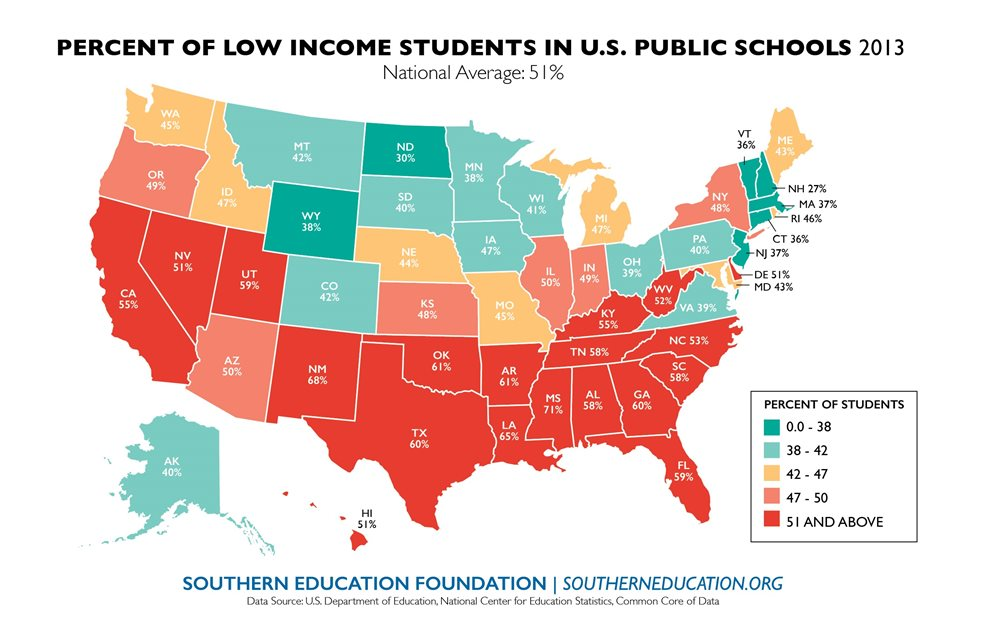
The study also suggests that American’s must reconsider previously held beliefs about the geographic reality of poverty. No longer can suburban school districts pretend to ignore this issue. The misconception that poor students are solely the responsibility of rural and inner-city schools is simply not true. According to Steve Suitts, the Foundation’s Vice president, “Even in the suburbs, low-income students are now 40% of the student population in the public schools…It’s everyone’s problem.”
Without improving the educational support that the nation provides its low income students – students with the largest needs and usually with the least support — the trends of the last decade will be prologue for a nation not at risk, but a nation in decline
“A New Majority: Low Income Students in the South and Nation. The Southern Education Foundation (2013)
This is an important statistic for educators to consider, as low-income students often require a more expensive education than their wealthier peers. Schools who service impoverished learners must account for the obvious gaps in resources. However, we must also consider the needs of kids who will not benefit of after school enrichment, summer camps, and families with the time and resources to help students grow at home. Most families want for their kids to learn and grow, but many do not have the time or money to give that desire a backbone. This is where schools have to pick up the baton.
As the Texas Legislature considers important school funding bills for the next biennium, it is imperative that they take into account the needs our State’s kids. Educators will need greater resources to provide for the new majority in Texas public schools. “Doing more with less” is simply not an option. The “more” these kids need is far too great to ignore and de-fund. If Texas lawmakers believe that our children are, in fact, an important resource for our State’s future, they simply must put their money where their mouth is.
Additionally, schools need flexibility with this funding to provide kids with services that might not have traditionally been within the scope of public education. Innovate teachers across the state will take the initiative to give all Texas kids what they need, but they need the time and money to make it happen. They also need the flexibility to do what’s best for their students and their community. School funding structures need to allow for this flexibility so campuses can make the important decisions they need to create school days that best serve the growing population of learner/breadwinners that go to school and support their families.
This issue is not just a political issue, it is a central economic reality for our State and our Nation. The strength of our National economy is dependent on the next generation of learners. The Foundation’s report says it best. “No longer can we consider the problems and needs of low income students simply a matter of fairness…Their success or failure in the public schools will determine the entire body of human capital and educational potential that the nation will possess in the future. Without improving the educational support that the nation provides its low income students – students with the largest needs and usually with the least support — the trends of the last decade will be prologue for a nation not at risk, but a
nation in decline”
No longer can we consider the problems and needs of low income students simply a matter of fairness…Their success or failure in the public schools will determine the entire body of human capital and educational potential that the nation will possess in the future.
“A New Majority: Low Income Students in the South and Nation. The Southern Education Foundation (2013)
 THINK Texas