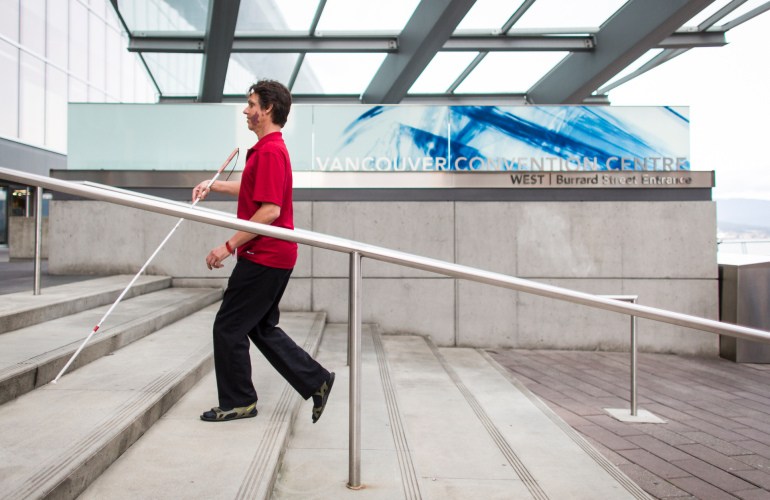
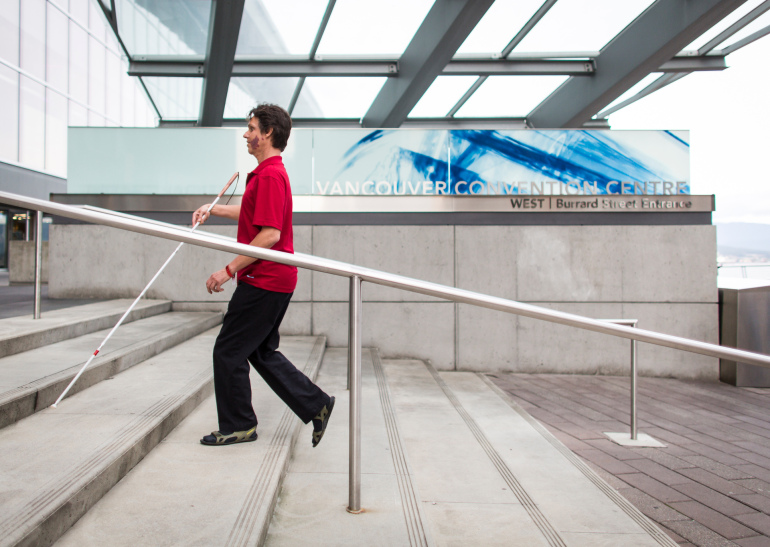
Daniel Kish on his way to speak to a TED audience about reaching new possibilities
I was listening to a TED talk from Daniel Kish, a man who, by his 2nd birthday, had lost both of his eyes to cancer. Mr. Kish describes in the talk how he has learned to use a variety of techniques, including echolocation, to paint rich landscapes in his mind’s eye and, in a sense, see the world around him. He now teaches these techniques across the globe and is changing the lives of many blind people.
I suggest you take the time to watch the talk in its entirety. He’s a remarkable human being.
Daniel Kish: How I use sonar to navigate the world
Early in the talk, Daniel speaks of his first days of blindness. While still in his hospital nursery, he climbed out of his crib and began to stumble around the room. “Wandering around the nursery without eyes,” he states, “was not a problem to me. The problem was getting caught.” He would soon learn that adults would try to protect him from the dangers of the world around him.
Kish speaks about the early role of fear in his life. He speaks to the common misconception that “blindness is thought to epitomize ignorance.” I believe we often make the mistake of thinking people who are “handicapped” in some way are less able to conceive of the world as we do, or at the very least to navigate it. We treat difference as something to be feared and avoided. Fear and ignorance were powerful forces in the lives of the people who surrounded this blind baby. Fear and ignorance are powerful forces in all of our lives. Amazingly, as is often the case of people who take on the world differently, Daniel Kish sees things in another light. And he sees things quite clearly.
He credits his earliest teachers with helping him gain this perspective.
“Fortunately for me, my parents knew ignorance and fear were but matters of the mind. And the mind was adaptable.”
Matters of the mind. What poetic thought: That we can simply change our minds and be freed from our fear and ignorance. Too often we are trapped by the idea of “truth.” To be blind is a fact. It seems immutable to so many of us. And yet, to this little family, it was simply a challenge to be faced. He goes on to say, “they knew the difference between love and fear.” He describes a childhood where his parents pushed him, rather than protecting him. He speaks of parenting that fosters bravery, rather than accepting limits. To Daniel’s parents, “love” meant teaching their sightless child to walk his own path, and set his own course. And to quite remarkable effect.
“Fear,” Kish says, “immobilizes us in the face of challenges.” We have a biological predisposition to self-preservation. This is often driven by fear and a desire to remain “safe.” Most species combat this trait with a laissez faire parenting style…pushing the birds out of the nest quickly so they learn to fly. Humans, for the most part, feel compelled to “protect” our young from the dangers of the world. Often, this continues through early childhood into school, where many teachers encourage students to find the “right” answer, rather than exploring new answers. Unless something has been “proven,” it has little merit in the education system. We see that in a world where a student’s ticket out of high school is based on her ability to get the “right” answers to a test, instead of her ability to find a solution to a challenge that is innovative and unique.
If we want to see what works in the modern world, we have to look to people like Daniel Kish. Rather than letting fear back him into a dark and sightless world, Daniel learned to use his other senses, including the often-ignored “sense of imagination,” to see the world in a way that we could never conceive. Along the way, I’m sure he stumbled more than once. I’m sure he got the answers wrong a few times. Most great people do. What makes Kish most remarkable, however, was that he did not let fear define him. With the help of adults who showed him what real love meant, he chose his strengths over his limitations, and found new ways to see the world. This is learning at its best. It’s amazing what you can learn when you are taught not to be afraid of making the wrong choice, but rather to see the unlimited choices that lay before us.
 THINK Texas